
If you're looking for authentic Italian craftsmanship famous worldwide, Tuscany is definitely the destination for you. This extraordinary land encompasses within its medieval villages and art cities a craft heritage of inestimable value, the result of over a millennium of traditions passed down from generation to generation.
As you well know, distinguishing authentic Tuscan craftsmanship from industrial products isn't always easy. The global market is flooded with imitations trying to exploit the prestige of Made in Italy, but true Tuscan craft excellence can be recognized by the superior quality of materials, the mastery of traditional techniques, and the uniqueness of each individual piece.
In this comprehensive guide, you'll discover all the secrets of the most prestigious craft traditions in the region. I'll take you on a journey to discover historic workshops, the master craftsmen who keep ancient techniques alive, and the sustainable innovations that are revolutionizing the sector, without ever losing sight of the authenticity that makes Tuscan design unique.

Tuscan craft excellence that conquers the world
Craftsmanship in Tuscany represents a precious heritage of the regional economy that has fascinated collectors, architects, and lovers of beauty worldwide for centuries. Each province contains treasures derived from human skill and materials offered by the territory: from worked gold and silver to bronze, from wrought iron to glass and crystal blowing and engraving, from ceramics to stone working, from fine textiles to luxury leather.
What makes Tuscan craftsmanship extraordinary is the perfect synthesis between millennial experience and continuous experimentation. Creativity, refined aesthetic sense, and technical competence transform into everyday objects crafted with sophistication and highest quality materials. Every single Tuscan city preserves craft treasures of inestimable value, worked using local raw materials and carrying forward a tradition deeply rooted in the territory.
Carrara marble: the art of sculpture that made history
Carrara marble is perhaps the most famous Italian material worldwide, used by artists and architects since antiquity. Who doesn't know the white, pure, veinless marble from the Apuan Alps, from whose great blocks Michelangelo carved David and the Pietà? Quarry exploitation began in Imperial Roman times and has never stopped, creating an indissoluble bond between this precious stone and world art.
The working of Carrara marble is an art requiring great skill and technical precision. Local craftsmen use traditional techniques to sculpt and polish marble, creating works of art of extraordinary beauty that decorate palaces, churches, and museums worldwide. Architecture, construction, furnishing, and art owe much to Carrara marble, but the metalworking sector has also benefited from this tradition, with the production of highly innovative machinery for excavation and granite processing.
Today Carrara marble adapts perfectly to home objects and contemporary furnishing elements like lamps, planters, and kitchen countertops. At the Marble Museum, the culture of working this material is preserved and valued through permanent collections, temporary exhibitions, and conferences celebrating this Italian excellence.
Montelupo ceramics: colors and tradition since medieval times
One of the oldest and most renowned forms of craftsmanship in Tuscany is Montelupo ceramics, from a town situated on the banks of the Arno whose soil is rich in clay. The history of Montelupo Fiorentino has been closely linked to ceramics since the 14th century, when this small city dedicated its craft production to Hispanic-Moorish inspired majolica.
During the Renaissance, production reached high quality standards, inspired by the works of masters from the Major Arts of Florence. The most important patrons were the Florentine families themselves, through whom Montelupo artifacts spread to noble residences throughout Europe. According to color and motif usage, decorations could belong to the "green family", the "Gothic floral" one, the "zaffera" one, up to "grotesques" and the seventeenth-century decoration called "harlequins".
Montelupo ceramics are known for their vivid colors and intricate motifs. Decoration techniques include the use of metallic oxides to create brilliant colors and the "spolvero" technique, which allows transferring complex designs onto the ceramic surface. Each piece is unique and requires hours of meticulous work.
Today the production of ceramics and majolicas is still very active in Montelupo and can be appreciated at the Ceramics Museum, in various city workshops, or at the International Ceramics Festival held every June. The museum preserves an incredible collection of a thousand works created from the late 13th to the 18th century.
Volterra alabaster: the Etruscan stone
In Volterra, since the time of the ancient Etruscans, a white stone much more malleable than hard marble has been worked. The gypsum alabaster extracted from the subsoil of Castellina Marittima is characterized by its extraordinary ductility, making it suitable for reproducing ornamental motifs rich in detail and portraying the human face in minute detail.
More than 2,500 years have passed since the Etruscans first began working it, but Volterra alabaster still endures and characterizes the area's history and culture. The initial phase of working involves design: a drawing is created, given to the craftsman, and he will transform it into reality with the help of chisels and electric tools like milling machines and sanders.
Objects created range from lamps and ceiling lights to chessboards, statuettes, and decorative items for furnishing. The Alabaster Ecomuseum is a distributed museum involving the locations of Volterra, Castellina Marittima, and Santa Luce, allowing discovery of the excavation and processing phases of this unique raw material.

Textiles and fashion: the productive heart of Italian excellence
Prato textiles: innovation and sustainability
Prato is an important center of Tuscan craftsmanship, known especially for textile production that has determined this city's economic growth since the Middle Ages. The city has a long tradition in wool processing, which has made it one of the main textile centers in Europe.
Prato textiles are appreciated for their quality and variety. Local companies produce a vast range of textiles, from the most traditional to the most innovative, using both craft techniques and cutting-edge modern technologies. A particularly interesting aspect of Prato's textile tradition is sustainability: many companies use recycled materials and ecological processes to reduce environmental impact.
The Prato Textile Museum is one of the world's most important dedicated to textile art and technology. In the Historical Hall, Coptic and pre-Columbian textile fragments, medieval artifacts, Venetian and Florentine Renaissance velvets are displayed. Ample space is also given to the contemporary part, with exhibitions and installations telling the evolution of this sector.
Casentino cloth: resistance and elegance since medieval times
Casentino cloth is a traditionally worked wool fabric with very ancient origins. The fabric is fulled (i.e., felted) and raised, making it waterproof and resistant. Due to these peculiarities, in the past it was often used by shepherds, woodcutters, and those working outdoors facing harsh winter weather.
Since the late 19th century, it became a fabric used for men's coats and jackets and today appears in shades ranging from brown to orange to green, in the form of modern and elegant clothing. The extremely resistant Casentino cloth was worn by personalities like Baron Bettino Ricasoli, Giuseppe Verdi, and Giacomo Puccini.
The Wool Art Museum is located in Casentino, in the small village of Stia, housed in the ancient Woolen Mill complex. The building is today a classic example of industrial archaeology and aims to enhance textile productions and territorial culture.
Florentine leather goods and leather: the art of luxury
Florence is synonymous with elegance and refinement, and leather craftsmanship is one of its oldest and most prestigious traditions. Florentine workshops produce high-quality leather items like bags, belts, wallets, and shoes that have become iconic Made in Italy products. Leather working in Florence dates back to medieval times, when the city was an important European commercial center.
The quality of Florentine leather is due to a combination of factors: the choice of high-quality hides, traditional tanning techniques, and craftsmen's skill. Vegetable tanning, for example, is a technique using natural tannins extracted from plants to treat leather, making it resistant and durable. This process can last several months, but the result is a product of exceptional quality.
Tuscan craftsmen are known for their attention to detail and ability to transform high-quality hides into wearable works of art. The workshops that work leather to create shoes, bags, and other items represent a distinctive characteristic of the Italian craft landscape.

Glass and crystal: the magic of Colle Val d'Elsa
The glass tradition that conquers the world
Colle Val d'Elsa is known as "Italy's Bohemia" for its extraordinary glass and crystal production. Its production represents the testimony of an ancient and refined art, that of glass and crystal production and engraving, which has medieval origins.
In 1820 Francesco Mathis opened a crystal factory that was later purchased by Giovan Battista Schmid upon his death. Glasses, bottles, vases, chandelier and lamp components, pharmaceutical items, and everyday objects were the result of months and months of work by master glassmakers who used locally sourced raw materials.
Today in Colle Val d'Elsa, 95% of Italian crystal and 14% of world crystal is produced. Visiting the Crystal Museum offers the opportunity to appreciate refined craft and artistic works like the "crystal forest".
Empoli glass: tradition and innovation
Empoli and its surroundings are known for their Tuscan glass craftsmanship, an ancient tradition linked to wine production with the typical green glass flask. The connection between the city and glass craftsmanship has ancient origins: glass was used to preserve and distribute salt from Volterra mines.
After a golden period between the two world wars, currently Empoli green glass is worked together with blue and yellow glass. Also notable is artistic glass, both blown and hand-worked. In Gambassi, in Valdelsa, glass production has been documented since the 13th century.
The MUVE - Empoli Glass Museum, housed in the ancient Salt Warehouse built in the second half of the 14th century, tells the story of local production with settings, videos, and historical documentaries.
Amarzo: when tradition meets sustainability
In the heart of Colle Val d'Elsa, the glass tradition meets sustainable innovation thanks to Amarzo, a laboratory dedicated to glass recovery and reuse. This project perfectly represents the contemporary evolution of Tuscan glass craftsmanship, keeping alive the ancient techniques of master glassmakers while embracing circular economy principles.
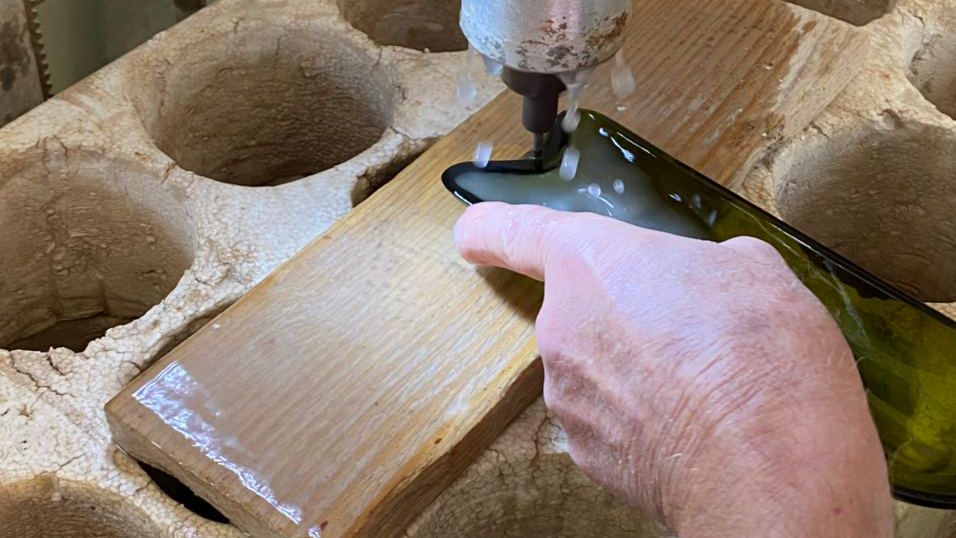
Amarzo transforms the 8 billion bottles thrown away each year in recycling collection into unique and functional design objects. The processing procedure involves recovering bottles destined for recycling, sterilization and cutting with special machines, then creating original and ecological craft objects.
Amarzo products include a vast range of home accessories made from 100% recovered glass: from recycled glass pitchers available in Barbera (ivory black), Primitivo (brilliant green), and Malvasia (pastel yellow) colors, to colored glasses sets with satin finish made by Tuscan glass craftsmen.
Particularly appreciated are coordinated sets like "Primitivo" (0.65L pitcher with 4 green glasses) and "Super Tuscan" (6 multicolored glasses), which represent the excellence of contemporary Tuscan design. The innovative finger food spoons carved from bottle necks and refined recycled glass trays demonstrate how craft creativity can transform waste materials into functional works of art.
The "Fenestra", sectioned bottle available in three formats (0.75L, 1.5L, and 3L), represents the perfect marriage between craft tradition and modern design, the result of 6 processing procedures using exclusively water and diamond grinding wheel.

Other treasures of Tuscan craftsmanship
Impruneta terracotta: the art of fired clay
Another important clay derivative is Impruneta terracotta, made famous by the excellent production of this ancient town south of Florence. The tradition dates back to the Middle Ages and is characterized by vases of every shape and size, in addition to the characteristic jars that once served to contain oil and wine.
Over the centuries, this beautiful material has come to cover roofs, decorate facades, and ornament gardens. Even today, terracotta products made in the area's kilns are widely used both in construction and interior and exterior furnishing. The most famous Impruneta terracotta is used for architectural elements of Tuscan noble villas up to the tiles of the Florence Cathedral.
Arezzo gold: goldsmith excellence
Arezzo has developed its economy around gold working, achieving world primacy. Goldsmith workshops specialize in creating unique pieces and precious objects made through craft techniques. The tradition of Italian goldsmith craftsmen is renowned for unique and precious creations, with Arezzo representing one of the most important centers along with Florence.
"OroArezzo", the International Exhibition of Goldsmithery, Silversmithery, and Jewelry, is a traditional trade appointment that gathers productive excellence from all Italian goldsmith districts.
Casentino wrought iron: ancient and modern art
In Casentino, an ancient form of Tuscan craftsmanship is wrought iron, so much so as to give life to the "National Ironworking Art Biennial" in Stia. This event brings together blacksmiths from all over Italy and Europe, participating in a competition and exchanging information on new techniques.
Florence perfumes: the art of fragrance
Florence is considered a cradle of perfumery art, with origins dating back to the Renaissance and the Medici court. The art of Florentine perfumery originates from the customs of Renaissance court and nobility, but it was with Catherine de' Medici and Renato Bianco that Florence became renowned in this field.
In Florence's center, even today, ancient and traditional workshops continue to create intoxicating high-quality perfumes, some of which create custom products.
Tuscan craftsmanship in the future: sustainability and innovation
The new generation of craftsmen
Tuscan craftsmanship is experiencing a renewal phase thanks to a new generation of craftsmen who combine respect for centuries-old traditions with attention to environmental sustainability. These new master craftsmen adopt sustainable practices, use recyclable materials, and integrate modern technologies while always keeping the quality of manual work at the center.
Modern craft design manages to reconcile tradition and modernity, creating products that respect the environment without sacrificing aesthetics and functionality. The circular economy is becoming increasingly central in craft workshops, where reuse and valorization of waste materials become sources of creativity and innovation.
Valorization and preservation of traditions
Tuscan craft traditions represent a cultural heritage of inestimable value that reflects the history, creativity, and skill of local craftsmen. Numerous festivals and craft fairs are organized throughout Tuscany, offering craftsmen the opportunity to exhibit and sell their products.
Many schools and academies offer training courses in various craft disciplines, allowing young people to learn traditional techniques and start a career in craftsmanship. These training programs are essential to ensure the continuity of craft traditions and to keep Tuscan culture alive.
In Florence, every spring, the International Craftsmanship Exhibition is held, now in its 82nd edition, testimony to the vitality and importance of this sector.

Conclusions: a heritage to discover and valorize
Italian craftsmanship famous worldwide finds its most authentic and refined expression in Tuscany. From Montelupo ceramics to leather working in Florence, from Prato textiles to Carrara marble, each form of craftsmanship tells a unique and fascinating story that continues to evolve over time.
Preserving and valorizing these traditions is fundamental to keeping Tuscan culture alive and supporting local craftsmen. In an increasingly globalized world, where mass products dominate the market, Tuscan craftsmanship reminds us of the importance of quality, skill, and creativity.
Each craft piece is a unique work, the result of hours of meticulous work and passion for one's craft. Supporting Tuscan craftsmanship means not only preserving an ancient tradition, but also promoting a sustainable and environmentally respectful production model.
We recommend visiting Tuscany and taking time to explore its craft workshops. You'll discover a world of beauty and creativity, and perhaps find a unique treasure to take home as a memento of this fascinating region, living testimony to Italian excellence that continues to conquer the world.

![Vassoio con Collo di Vetro Riciclato [Lav. Lucida]](http://amarzo.com/cdn/shop/products/vassoio-con-collo-125288.jpg?v=1699712421&width=550)