
Have you ever wondered what mysterious alchemy lies behind the creation of a simple glass?
The art of glassworking, known by the technical term hyalurgy, represents one of the most fascinating testimonies of human ingenuity. From the first Mesopotamian experiments to contemporary sustainable innovations, this millennial discipline continues to surprise us with its ability to transform elementary raw materials into works of extraordinary beauty.
For over five thousand years, master glassmakers have guarded the secrets of an art that merges science and creativity. The fusion of silicon dioxide at temperatures reaching 1600°C is not just a technical process: it's an ancient dance between fire and matter, where every gesture encompasses centuries of tradition.
Today this cultural heritage is renewed through sustainable innovation. Centers of excellence like Murano, Piegaro and Colle Val d'Elsa continue to write new chapters of this millennial story, while companies like Amarzo demonstrate how cold grinding and recycled glass can be the key to a more responsible future.

History of hyalurgy: from origins to the glass renaissance
The Mesopotamian roots of glass art
The first traces of the art of glassworking have their roots in Mesopotamia of 5000 B.C., when pioneer artisans began experimenting with the fusion of siliceous sands.
Clearly, these first artifacts were far from the refinement we know today. However, even in that era glass was considered a precious material, so much so that in ancient Egypt of 2000 B.C. it was used to create tableware and jewelry of great value.
The Mediterranean soon became the nerve center for the diffusion and commercialization of these extraordinary objects. As you well know, the extensive exportation favored the birth of furnaces in Campania, Spain and in Rome, which was particularly active during the early Middle Ages.
The Roman glassblowing revolution
A decisive moment in the history of hyalurgy occurred in the 1st century B.C. with the development of the glassblowing technique. This innovation, which originated in the regions of Syria and Lebanon, completely revolutionized the production process.
You might be wondering what made this technique so special.
Glassblowing allowed the creation of thinner and lighter objects, opening new creative possibilities for master glassmakers. Furthermore, Byzantine art between the 5th and 7th centuries A.D. began using glass tesserae for its spectacular mosaics, further elevating the prestige of this material.
Around the year 1000, in Germany, glassmakers devised the first glass sheets, while also in this period the first eyeglasses with glass lenses were born, testifying to the continuous evolution of working techniques.
The rise of Venice and the prestige of Murano
Venice, with its furnaces on the island of Murano, established itself as the world capital of glass art during the Middle Ages and Renaissance.
The Venetian master glassmakers didn't limit themselves to perfecting existing techniques: they constantly innovated, creating the modern mirror through the application of tin and mercury foils on polished crystal sheets. Their mastery became legendary throughout Europe, making Murano synonymous with excellence in the sector.
After Venice, in terms of importance and mastery, the Savona furnaces and Tuscan ones stood out. It is precisely from this Tuscan tradition that the glass art of Piegaro probably derived, favored by the presence of Benedictine abbeys and the strategic proximity to the Opera of Orvieto Cathedral.

The historic centers of Italian glass art
Piegaro and specialization in mosaic tesserae
The history of glass art in Piegaro officially begins in 1250, according to a document written in 1860 by the Gonfaloniere Ludovico Vicaroni. However, the territory's conditions suggest this tradition may be even more ancient.
The presence of monastic orders spreading artisan techniques, the integration into the Umbrian-Tuscan road network, and especially the enormous availability of fuel thanks to vast woodland expanses, created ideal conditions for the development of hyalurgy.
In 1321 we find the first official historical documentation of the participation of Piegaro masters in the decoration of Orvieto Cathedral. Lorenzo Maitani, architect of the Cathedral, initially turned to the furnace of Monteleone d'Orvieto, but subsequently chose that of Piegaro for the superior quality and quantity of glass produced.
The choice fell on the Piegaro masters precisely because they provided superior quality: this suggests they had a well-established tradition, considering that creating delicate mosaic tesserae required years of specialized experience.
A particularly interesting detail concerns the use of zaffara to color glass blue: this material is mentioned in Piegaro documents as early as 1360, while in Murano documents it doesn't appear before 1446, testifying to the technical avant-garde of the Umbrian center.
Ancient recipe books and secret techniques
Fifteenth-century documents reveal fascinating recipes for the composition and working of special mosaic tesserae. For example, the silver leaf mosaic plates of the 12th century, called "glass tongues", measured exactly 17.5 cm by 6-7 mm thick.
An anonymous 16th-century recipe book describes in detail the process of creating gold mosaic: "Take 100 pounds of common frit, 33 pounds of lead glass, put in crucible to melt and refine; then blow a large flask with walls as thin as possible."
The process continued with breaking the flask into pieces the size of beaten gold leaf, preparing a solution with egg white and water, applying the gold leaf, and finally slow annealing to prevent breakage.
Comparing these Tuscan documents with Venetian Renaissance manuscripts, it emerges that the techniques were substantially identical, suggesting a common heritage of knowledge that crossed regional boundaries.
The golden age and the 18th-century decline
Historians identify the 17th century as the period of maximum prestige of the Piegaro glassworks, confirmed by the presence of a Glassmakers' Lordship, called after 1576 Gonfalone della Crocetta.
The artisans were not only masters in the art of mosaic, but also excelled in creating common-use objects. They were called "glass makers and flask makers", producing objects that were no less creative or complex than artistic works.
In 1480, the fame of Piegaro masters was such that they were called to Gubbio by Duke Federico II to practice their art, producing tableware and furnishings for the Montefeltro court. The stay of the Duke of Calabria in Piegaro in 1485 and the purchase of "beautiful flasks" produced in the local glassworks is historically documented.
At that time there were two main furnaces and probably other small furnaces to produce frit, the first partial glass melting step that occurred at 650-700°C.
The 18th century marked a slow decline due to competition from Bohemian Crystals, crystal clear and ground, difficult to imitate with the technologies of the time. The Piegaro master glassmakers failed to start an industrialization process, limiting production to traditional flasks.
Colle Val d'Elsa: the "crystal city"
Colle Val d'Elsa represents today one of the most important centers for glassworking in Tuscany. Nicknamed "Bohemia of Italy" or "Crystal City", this ancient medieval town currently produces 95% of Italian crystal and 14% of world crystal.
The local glass tradition has roots in the Middle Ages, when artisans knew how to wisely exploit the territory's natural resources: siliceous sand, quartzite, carbonate, magnesium, abundant water and timber.
In 1800, Francesco Mathis built the first modern crystal factory, beginning the industrialization of the sector. However, the artisan tradition has never been completely lost, and today centers like the Amarzo laboratory demonstrate how it's possible to combine traditional mastery and sustainable innovation.
Traditional glassworking techniques
Glassblowing: the art of divine breath
Glassblowing remains the most iconic and recognizable technique of glass art. This method, introduced over two thousand years ago, requires the use of a long metal tube called a blowpipe, through which the master glassmaker blows air to shape molten glass into intricate forms.
The process begins with gathering molten glass from the furnace at a temperature of about 1100°C. The glassmaker rolls the incandescent glass around the end of the pipe, creating a sort of "gather" that forms the base of the object.
Subsequently, through coordinated movements of blowing and rotation, the master shapes the glass creating hollow forms like vases, bottles and lamps. Variations of this technique include mold blowing, which allows the creation of more uniform and complex objects while maintaining the authenticity of manual working.
Each piece requires extraordinary skill and precision, as the glass must be shaped before it cools completely, creating unique artifacts that reflect the individual mastery of the artisan.
Lampworking: millimetric precision
Lampworking represents a refined technique that uses a flame to melt glass while it's shaped with specific tools and extremely precise manual movements.
This methodology is ideal for creating small detailed objects like beads, decorative figures and small sculptures. The glass, generally in rod form, is gradually heated in the flame to the melting point, allowing the master glassmaker to shape it with surprising precision.
Lampworking requires millimetric control of temperature and working times. Every movement must be calculated with extreme attention, as the margin for error is minimal when working on such a small scale.
Traditional decorative techniques
Filigrana: the art of weaving
Filigrana represents one of the most ancient and fascinating decorative techniques of glass art. It's created by placing glass filaments with colored core on a plate: initially they're melted, then the object to which they must adhere is applied, often cylindrical in shape.
The reticello constitutes a particularly complex variant of filigrana, characterized by the double weaving of filaments, creating geometric patterns of extraordinary beauty and technical complexity.
Murrina: the art of design in glass
The murrina technique consists of arranging numerous glass canes or filaments of different colors to form a specific design. The filaments are then fused and cut transversely to be finally applied to an object, creating sections that reveal the projected pattern.
Each murrina is essentially a "visual story" trapped in glass, where colors and forms combine to create unique artistic narratives.
Incalmo: the perfect union
Incalmo, another technique of Venetian origin, consists of the union of two or more masses of differently colored glass through their hot modeling. This technique requires perfect synchrony between master glassmakers, as the different masses must be at ideal temperature at the exact moment of union.
Specialized finishing techniques
Aventurine: copper crystals
Aventurine represents an extremely difficult, delicate and slow technique, born in Murano in the 17th century. The glass presents tiny copper crystals inserted during the cooling process and dispersed with perfect homogeneity.
Creating Aventurine requires deep knowledge of cooling times and chemical reactions occurring inside the glass, making each piece a small technical miracle.
Battuto: the wrought iron effect
The Battuto technique consists of actual cold grinding of the glass surface to give an appearance similar to wrought iron. This process creates unique textures that play with light in a completely particular way.
Calcedonio: stone imitation
The Calcedonio technique involves inserting various metals of different colors to make the glass appear similar to natural stone. This working demonstrates how historical master glassmakers were also skilled "illusionists" capable of transforming glass into apparently different materials.

Modern innovations and sustainability in glass art
The cold grinding revolution
Technological innovation has introduced revolutionary methodologies in the panorama of contemporary glass art. Cold grinding represents one of the most significant evolutions, allowing glass to be worked with extreme precision without exposing it to high temperatures.
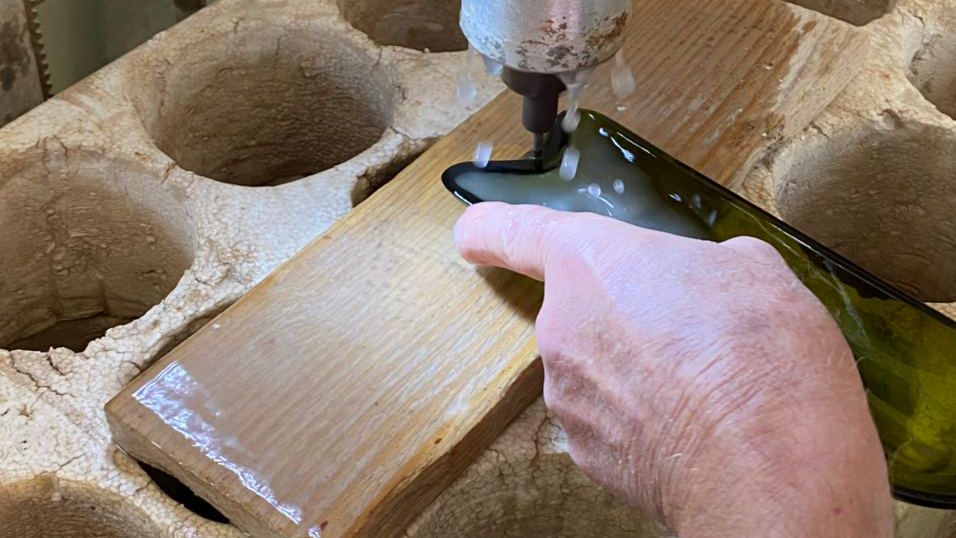
This technique, successfully adopted by companies like Amarzo in Colle Val d'Elsa, preserves the structural integrity of glass while maintaining the aesthetic qualities of the material intact. The process uses water and diamond wheel, guaranteeing high-quality finishes while drastically reducing energy consumption.
Cold grinding allows obtaining polished edges with polishing precision between 600-800 grit and thickness controlled to ±1 mm, precision standards unthinkable with traditional techniques.
Advanced industrial processes
Lamination and drawing
Lamination is adopted to create flat products and is performed through steel rollers under which the molten mass flows via a continuous belt system. Drawing presents characteristics similar to lamination, differing in the vertical positioning of the rollers.
Spinning and pulling
Spinning concerns the production of glass fibers with extraordinary mechanical resistance capacity. Pulling occurs through high-speed mechanical machinery that produces filaments used to reinforce composite materials, such as boat hulls.
The circular economy in glass
Recycled glass: infinite resource
Recycled glass represents one of the greatest opportunities of the modern circular economy. With its infinite recycling capacity, glass confirms itself as a pillar of environmental sustainability, significantly reducing the ecological impact of production.
About 8 billion bottles are thrown into separate collection annually after a single use. However, glass can be 100% recycled without losing quality, transforming what was previously considered waste into valuable secondary raw material.
Environmental advantages of recycling
Recycled glass offers extraordinary environmental advantages: it reduces the need for virgin raw materials, decreasing mineral extraction and consequent environmental degradation. Using recycled glass limits CO2 emissions associated with new glass production, concretely contributing to the fight against climate change.
The artistic versatility of glass allows infinite creative possibilities, transforming simple everyday contents into complex works of art through creative reuse.
Innovative cutting and grinding techniques
Specialized cold cutting
Cold cutting of bottles represents one of the most interesting applications of modern technologies. This technique allows working wine, beer and liquor bottles using diamond wheels that guarantee clean and precise cuts.
The processes include belt grinding in standard, polished, matte or satin variants, glass drilling for creating candles or lamps, and diamond lathe finishing to obtain particularly delicate edges.
Assembly and customization
Modern techniques allow gluing and assembly for composite items, opening new creative possibilities. Customization through laser engraving, sandblasting and logo application techniques represents the contemporary evolution of ancient decorative tradition.

Contemporary masters and case studies
Amarzo: Tuscan tradition and sustainable innovation
Amarzo represents a perfect example of how Tuscan artisan tradition can meet sustainable innovation. Located in the heart of Colle Val d'Elsa, this artisan reality has developed a production philosophy based on the principle that "reusing comes before recycling".
Amarzo's production process begins with careful selection of wine bottles destined for recycling. Through professional sterilization and subsequent cutting with special machines, each bottle begins its transformation into a design object.
Cold grinding without CO2 emissions represents the heart of technical innovation: this methodology allows working glass with extreme precision while maintaining the original aesthetic properties of the material intact.
Iconic products of the Amarzo collection
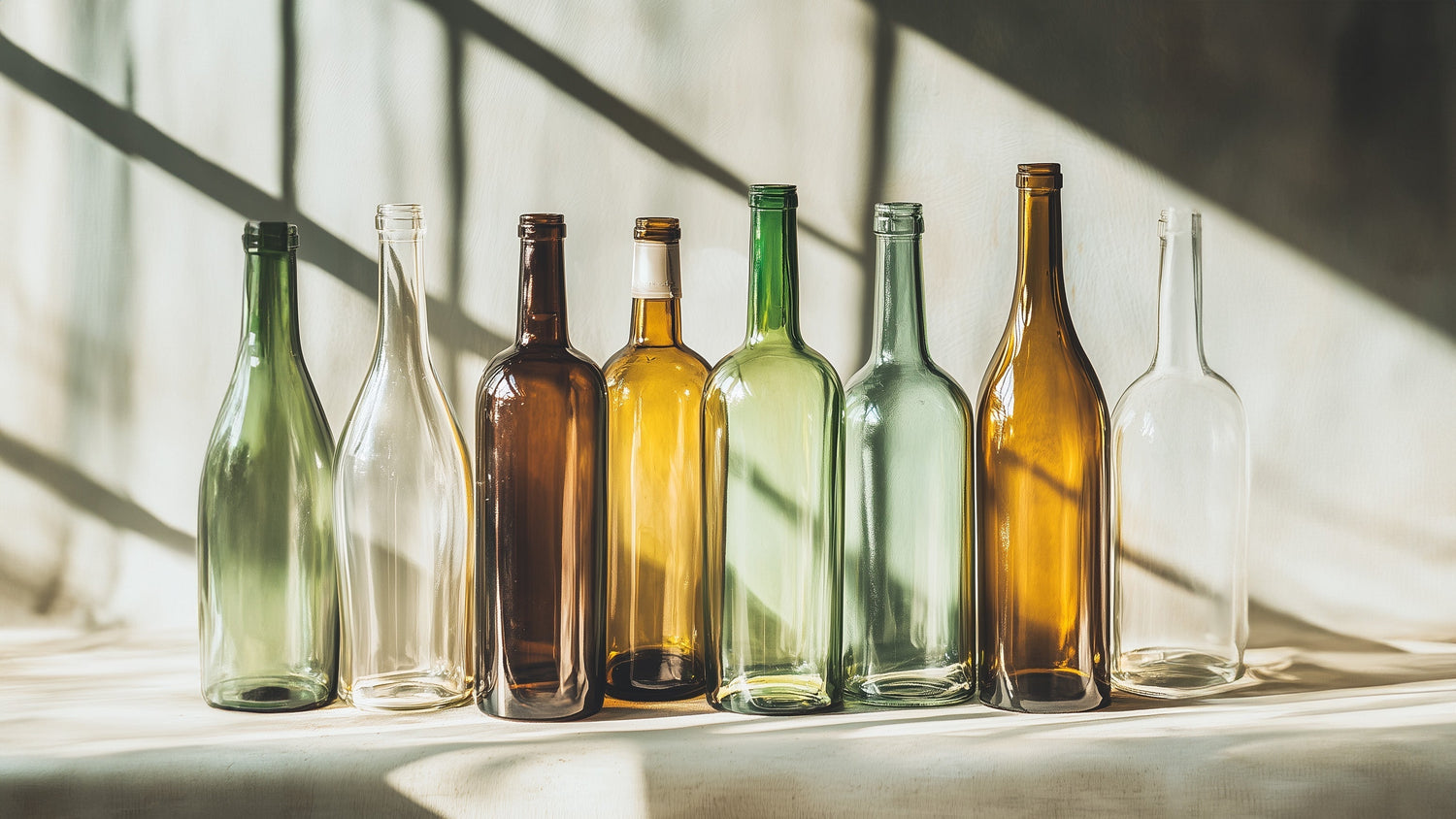
The Supertuscan set glasses represent excellence in contemporary working. Each set includes 6 glasses in different shades: brownish, black, yellow, bright green, light green and white. Artisan working with water and diamond wheel guarantees impeccable finishes without producing harmful emissions.
Recycled glass pitchers demonstrate how oblique cutting and anti-drip spout shape can transform a simple bottle into a functional object of great elegance. Available in Barbera, Primitivo and Malvasia models, each pitcher tells a story of sustainable transformation.
Particularly innovative are the coffee cups with 50/70ml capacity and 3x3x5cm dimensions. Each cup weighs only 70g but contains centuries of Tuscan glass mastery applied to contemporary sustainability.

Applied circular economy
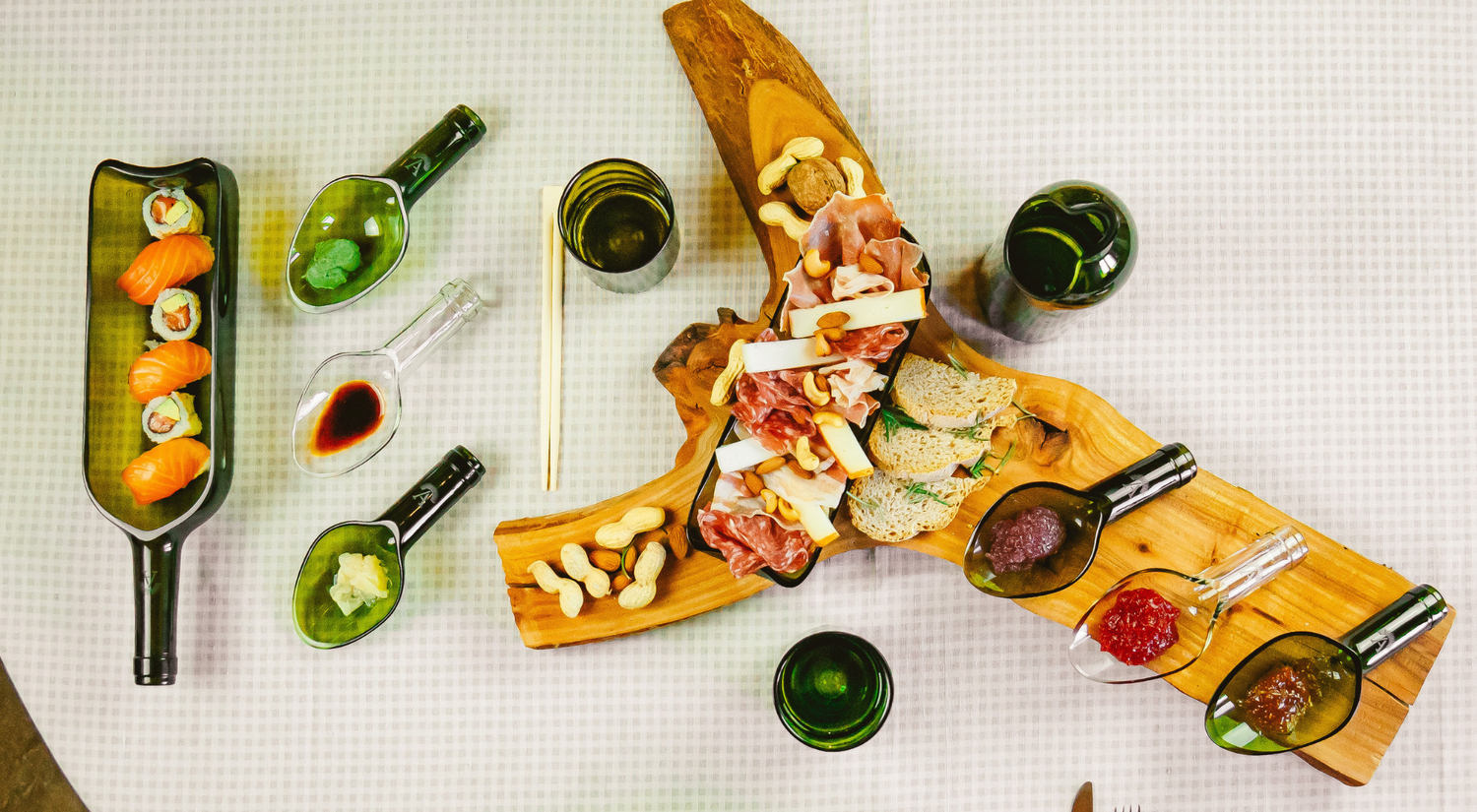
Amarzo trays represent a perfect example of circular economy: obtained from longitudinal cutting of bottles, they're available in 4 varieties (Barbera with neck, half neck, sparkling with neck, Barbera without neck) and demonstrate how every part of the bottle can find new functional life.
The finger food spoons constitute the most refined expression of this approach: they derive from remaining parts of pitcher processing, transforming what could be waste into elegant table accessories. With 14x7cm dimensions and 100g weight, available in three colors (ivory black, pastel yellow, bright green), these spoons represent innovation in tradition.
Quantified environmental impact
Thanks to glass recycling, Amarzo has documented savings of 19,544 kg of fuel and about 28,534 kg of CO2, demonstrating how sustainable craftsmanship can have a measurable and significant environmental impact.
This data highlights how every single object produced through creative reuse concretely contributes to reducing the carbon footprint of the sector.

Future perspectives of glass art
Emerging application fields
The art of glassworking is expanding into potential fields not yet completely explored. Creative construction is experimenting with the use of recycled glass bricks, while hotel interior design is developing modular glass walls that combine functionality and aesthetics.
Cut glass flooring and luminous architectural elements represent innovative frontiers where traditional glass art meets contemporary design needs. Particularly promising is the luxury artistic packaging sector, where hand-worked glass adds perceived value to premium products.
Integrated technologies and digitization
The integration between centuries-old artisan techniques and cutting-edge methodologies is opening new creative possibilities. Computer-aided design allows visualizing and perfecting designs before realization, while digital quality control systems guarantee increasingly high precision standards.
Digital hyalurgy represents a fascinating frontier where tradition meets 4.0 innovation, maintaining intact artisan authenticity while benefiting from possibilities offered by modern technology.
Sustainability and environmental responsibility
The future of glass art will inevitably be linked to environmental sustainability. The goal of using only recycled glass to obtain economic and ecological savings is becoming increasingly concrete, while developing a complete circular economy in the sector represents a stimulating challenge for contemporary master glassmakers.
The creation of carbon-neutral processes and amplification of sustainability leadership are redefining excellence parameters in the sector, where aesthetic quality must necessarily combine with environmental responsibility.
Conclusions: the continuing legacy
The art of glassworking represents one of the most extraordinary testimonies of human capacity to transform simple elements into works of beauty and functionality.
From Mesopotamia of five thousand years ago to contemporary sustainable laboratories, hyalurgy has maintained its ancestral fascination intact while constantly evolving to respond to the needs of each era.
Today's master glassmakers, like those of Amarzo and the historic centers of Murano, Piegaro and Colle Val d'Elsa, are not simple guardians of past traditions: they are innovators writing new chapters of this millennial story.
The contemporary challenge consists of keeping artisan authenticity alive while embracing opportunities offered by sustainability and the circular economy. Every glass obtained from a recycled bottle, every pitcher shaped with cold grinding, represents a bridge between past and future.
Is everything clear so far?
At this point you have all the tools to appreciate the extraordinary complexity and beauty of the art of glassworking. All that remains is to continue admiring and supporting this tradition that, through responsible innovation, will continue to enchant future generations.
Hyalurgy is not just a technique: it's living testimony that the most authentic art is born from the meeting between traditional mastery and contemporary vision.

![Vassoio con Collo di Vetro Riciclato [Lav. Lucida]](http://amarzo.com/cdn/shop/products/vassoio-con-collo-125288.jpg?v=1699712421&width=550)