
Have you ever been fascinated by how a simple bottle can transform into a functional art object?
Italian glass craftsmanship represents one of the most extraordinary excellences of our cultural heritage, an art that has its roots in ancient times and today reinvents itself through sustainability practices and circular economy.
In the contemporary landscape, we are witnessing a true renaissance of glass craftsmanship, where master glassmakers skillfully combine traditional techniques with innovative approaches to create unique pieces that tell stories of passion, territory and respect for the environment.

The millennial history of glass craftsmanship in Italy
From Roman origins to Renaissance excellences
The art of glassworking in Italy boasts ancient origins.
As well documented, in the Roman era glass was already used to produce tableware, jewelry and decorative objects, with the Mediterranean serving as the nerve center for the diffusion and commercialization of these precious artifacts.
The techniques were progressively refined thanks to the skill of craftsmen: in the 1st century BC the revolutionary blowing technique was developed, while between the 5th and 7th centuries AD Byzantine art began to use glass tesserae for its spectacular mosaics.
Venetian excellence and the island of Murano
Venice and its famous island of Murano established themselves as the world epicenter of glass art.
At the end of the 13th century, Venetian authorities made a strategic decision: to transfer all the city's glass furnaces to Murano, both to control the risk of fires and to jealously protect the secrets of glass art from commercial rivals.
The glass masters, known as "maestri", became true celebrities of craftsmanship, developing extraordinary techniques that still today define the excellence of Murano glass.
Among the most refined techniques emerged filigrana (the intricate fusion of glass threads), lattimo (the dreamy milk-white glass) and millefiori (colored mosaics reminiscent of floral compositions).
Tuscan excellence: tradition and innovation
Colle Val d'Elsa, the "Bohemia of Italy"
In the panorama of Italian glass craftsmanship, Tuscany occupies a position of absolute prestige.
Colle Val d'Elsa, nicknamed the "Bohemia of Italy" or "City of Crystal", today represents a world-class production hub, producing 95% of Italian crystal and 14% of world crystal.
This ancient Tuscan medieval town has been able to exploit its local natural resources: siliceous sand, quartzite, carbonate, magnesium, water and timber have constituted the foundations for a tradition that has its roots in the Middle Ages.
The turning point came in 1800, when Francesco Mathis built the first crystal factory, starting what would become an internationally renowned industrial district.
The glass tradition between Montaione and other Tuscan excellences
The Tuscan tradition of glass craftsmanship extends well beyond Colle Val d'Elsa.
Montaione boasts documentation of its own glass tradition dating back to 1279, with a specialization in the production of glasses and glass objects that from 1700 extended to the creation of containers for wine bottling.
Piegaro, linked to the presence of Benedictine abbeys and proximity to the Opera del Duomo di Orvieto, has also developed its own identity in glass art. The Piegaro furnace was able to specialize in the production of mosaic tesserae, glass sheets for windows, in addition to glasses and flasks, reaching the peak of its prestige in the 17th century.

Traditional techniques and contemporary innovations
Glass blowing: art and precision
Glass blowing represents the most iconic and fascinating technique of glass craftsmanship. In this extraordinary process, the craftsman immerses a long hollow tube in a furnace that reaches temperatures above 1800°C, collecting the molten glass at the tip of the tool.
With the precision of a surgeon, the glass is delicately shaped using wooden tools or iron benches, while the craftsman blows air through the tube, creating a bubble that expands into complex and harmonious shapes.
Glass and crystal grinding: differences and subtle beauties
The art of glass and crystal grinding reveals substantial differences between these two materials.
Common glass is composed mainly of silica, soda and lime, while crystal contains lead oxide (typically between 18% and 35%), which gives it unique characteristics.
Crystal is distinguished by its greater hardness and scratch resistance, superior light refraction that creates extraordinary luminous effects, more substantial weight and a more clear and melodic sound when struck.
Cold grinding: sustainable innovation
One of the most innovative techniques of contemporary craftsmanship is cold grinding.
This revolutionary methodology does not use heat during processing, keeping the original properties of materials intact and offering a finish of the highest precision and quality.
The advantages of cold grinding are multiple: it preserves the molecular structure of materials, guarantees a finish of high precision, significantly reduces energy consumption and minimizes the environmental impact of the production process.
Sustainability and circular economy in glass
Recycled glass: infinite resource
Glass represents an extraordinary material from the point of view of environmental sustainability.
Its most revolutionary characteristic is infinite recyclability: it can be remelted and reshaped countless times without losing its physical and chemical properties.
Considering that 8 billion bottles are thrown into separate waste collection every year after a single use, the opportunity for reuse and creative recycling takes on extraordinary economic and environmental dimensions.
From waste to art: the philosophy of reuse
The philosophy "reuse comes before recycling" is revolutionizing the approach to glass craftsmanship.
This principle allows for the direct transformation of used wine bottles into functional and decorative objects, avoiding the energy-intensive remelting process.
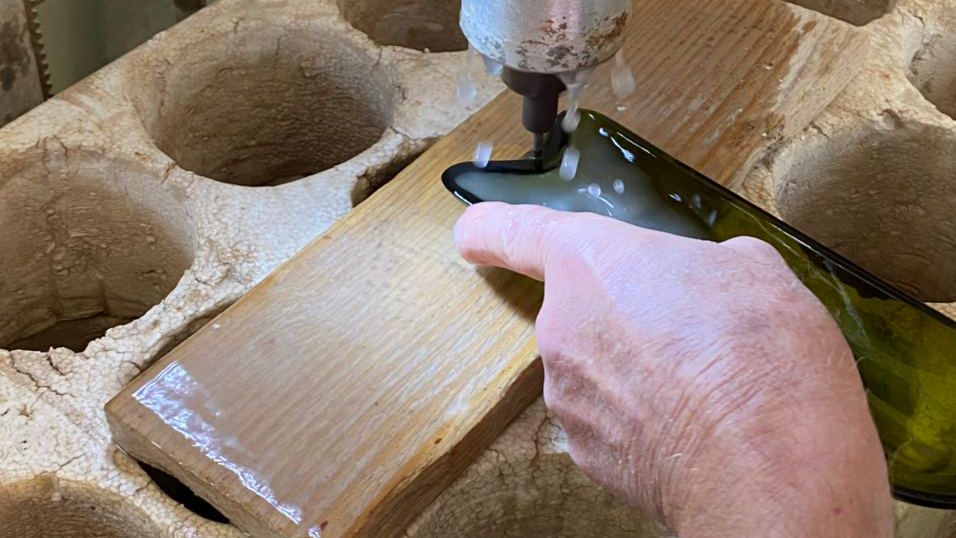
Glass bottles are subjected to sterilization and cutting processes with specialized machines, then worked through grinding techniques that use exclusively water and diamond wheels, without producing harmful emissions.
Quantifiable environmental benefits
The adoption of circular economy practices in the glass sector generates measurable environmental benefits.
Glass recycling results in a 5% reduction in greenhouse gas emissions for every 10% of recycled glass used in production, in addition to drastically reducing the consumption of natural resources and energy needed for production.
Master craftsmen and contemporary workshops
Tuscan artisanal excellence
In the heart of Valdelsa, precisely in Colle Val d'Elsa, master glassmakers operate today who perpetuate centuries-old traditions through innovative approaches.
These specialized craftsmen combine millennial artisanal techniques with cutting-edge methodologies, creating a perfect balance between tradition and innovation.
The production process involves several methodical phases: careful selection of sustainable materials such as recycled glass, processing through traditional techniques, cutting and shaping phases, accurate assembly and final phase of cold grinding with precision tools.
The rediscovery of craftsmanship as a conscious choice
In recent years we are witnessing a true rediscovery of craftsmanship, motivated by growing environmental awareness and contrast to consumerism and pollution.
This trend focuses on quality, sustainability and attention to detail, values that mass industrial design often fails to guarantee.
The advantages of sustainable craftsmanship include the use of recyclable natural materials, promotion of circular economy, production of local km 0 products and use of manual processing that preserves traditional skills.
Products of contemporary glass craftsmanship
Table sets: elegance and functionality
Contemporary glass craftsmanship expresses itself through a diversified range of products that unite aesthetics and functionality.
The Pitcher and Glasses Sets represent the most iconic example of this production: the "Primitivo" Set in 100% recycled glass with bright green color (0.65l pitcher and 300ml glasses) demonstrates how satin processing can create soft and smooth surfaces of extraordinary elegance.
Similarly, the "Barbera" Set in ivory black (0.9/1.2l pitcher with 6 300ml glasses) shows how different workings can generate completely different aesthetic effects, from satin finish to polished one.
Design pitchers: functional innovation
Recycled glass pitchers represent a perfect example of how innovative design and environmental awareness can integrate harmoniously.
The pitcher with oblique cut and anti-drip spout shape (available in capacities of 0.4l, 0.9l and 1.2l) demonstrates how craftsmanship can solve functional problems through aesthetically refined solutions.
The minimal pitchers (0.75l) available in white and black represent the contemporary evolution of craftsmanship, with clean lines suitable for any modern furnishing context.

Coffee cups: excellence in miniature
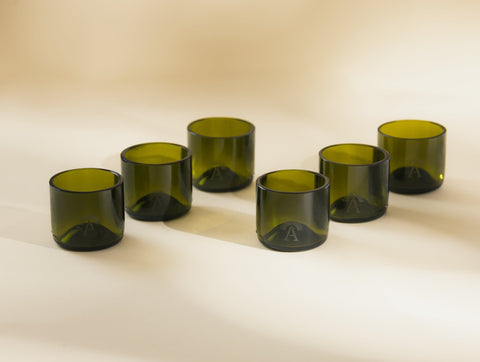
The recycled glass coffee cups (set of 6 pieces, capacity 50/70ml) embody the maximum expression of glass craftsmanship on a reduced scale.
Made from recycled wine bottles through the skillful intervention of Tuscan master glassmakers, these dark green cups with polished processing are heat resistant, dishwasher safe and represent a perfect balance between sustainability and functional design.
Specialized accessories: creative versatility
Glass craftsmanship also expresses itself through a range of specialized accessories that demonstrate the versatility and creativity of master craftsmen.
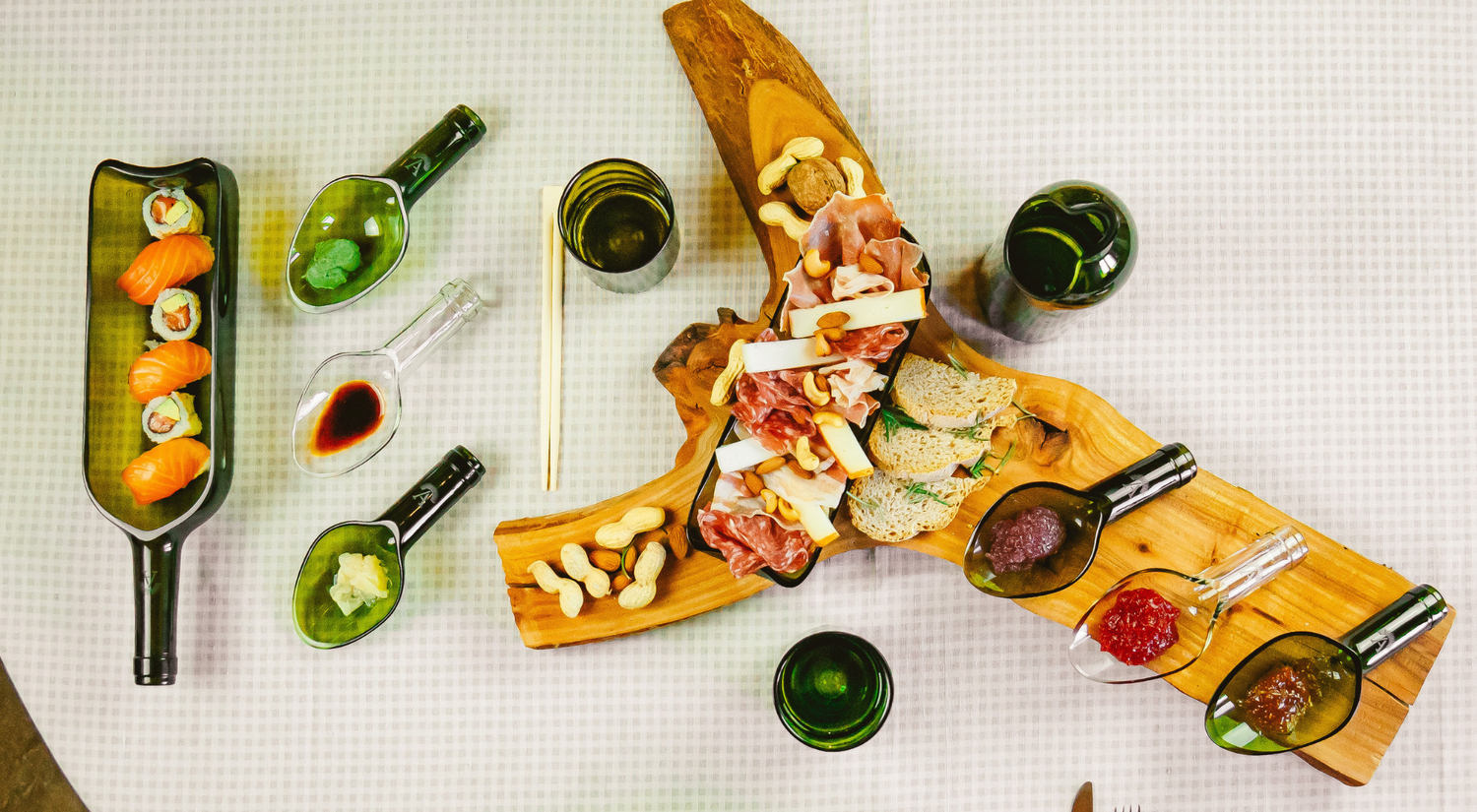
The recycled glass trays (available in 4 varieties: Barbera with neck, half neck, sparkling with neck, Barbera without neck) offer multifunctional solutions for table service, furnishing and home organization.
The finger food spoons (mix of 3 pieces obtained from bottle necks) available in Barbera, Primitivo and Malvasia colors demonstrate how every part of the bottle can be creatively valorized.
Office accessories such as the "Primitivo" pen holder (8x10cm/8x12cm, 280g) in bright green with oblique cut represent the extension of glass craftsmanship into contemporary work environments.

Lighting and decorative objects
Art lamps: light and sustainability
Bottle lamps in recycled glass represent one of the most poetic expressions of contemporary craftsmanship.
The "Lux" lamp with refined design and polished finish emits warm and welcoming light, transforming any environment into a sophisticated atmosphere space while celebrating the principles of circular economy.
Artisanal candles: fragrances and tradition
Scented candles in recycled glass (duration over 30 hours) combine the excellence of glass craftsmanship with the production of natural waxes from soy, palm and coconut.
The violet fragrance and prolonged duration demonstrate how sustainability and quality can coexist perfectly in contemporary craftsmanship.

Personalization and artisanal uniqueness
Engravings and personalizations
One of the most fascinating aspects of contemporary glass craftsmanship is represented by personalization possibilities.
The cutlery rests obtained from recycled bottle necks can be personalized through laser engraving with names, initials or company logos, transforming each piece into a unique and meaningful object.
This personalization capacity extends glass craftsmanship from simple functional object to memorable gift and personalized furnishing complement.

Glass craftsmanship for catering
Products for restaurateurs: differentiation and dialogue
In the catering sector, glass craftsmanship has found a particularly interesting new application dimension.
Water glasses obtained from Bordeaux and Burgundy bottles offer restaurateurs resistant, unique products capable of dialoguing with customers through their reuse story.
The pitchers of 750ml and 1.5 liters for water or bulk wine, trays for aperitifs and finger food, in addition to specialized spoons and cutlery rests, constitute a coordinated system that allows venues to effectively communicate their values of sustainability and quality.
Tangible results: the "wow effect"
Restaurateurs who adopt artisanal recycled glass products record tangible and measurable results. The so-called "wow effect" generated by these unique products stimulates customer curiosity, who frequently request information about the origin and history of objects, establishing a positive dialogue that increases the perceived value of the venue. Many restaurateurs report an increase in positive reviews linked to attention to aesthetic details, in addition to using objects in social content, generating visibility for both the restaurant and Italian craftsmanship.
Specific processing techniques
Hand processing: precision and dedication
Hand processing remains the beating heart of Italian glass craftsmanship.
Each piece is made using exclusively water and diamond wheels, through processes that do not produce harmful emissions and completely respect the environment.
Grinding techniques allow us to obtain smooth surfaces that are soft to the touch, with finishes ranging from satin processing to polished processing, offering practically infinite aesthetic possibilities.
The challenge of precision
Artisanal processing requires extraordinary technical skills and dedication that is passed down from generation to generation.
Every oblique cut, every shaping and every finish represents the result of years of experience and attention to detail that industrial automation can hardly replicate.
Future perspectives of glass craftsmanship
Innovation and tradition: a dynamic balance
The future of Italian glass craftsmanship is outlined through a dynamic balance between preservation of traditions and sustainable innovation. The goal is to use exclusively recycled glass to obtain significant economic and environmental savings, creating a completely sustainable circular economy model.
Education and knowledge transmission
The transmission of artisanal knowledge to new generations represents a crucial challenge for the survival of this millennial tradition.
Young craftsmen are developing innovative approaches that combine centuries-old techniques with contemporary environmental sensitivity, ensuring the continuity and evolution of Italian glass art.
Conclusion: craftsmanship as a life choice
Italian glass craftsmanship represents much more than a simple productive tradition.
It is a life philosophy that celebrates beauty, sustainability and respect for the environment, transforming waste materials into functional works of art that tell stories of passion, territory and mastery.
From crystal grinding in Murano to innovative cold techniques in Valdelsa, from traditional blowing art to modern creative recycling processes, Italian glass craftsmanship continues to evolve while keeping intact its DNA of excellence and uniqueness.
Choosing glass craftsmanship products means supporting a responsible, local and environmentally respectful production model, contributing to the preservation of skills that constitute an invaluable heritage of our culture.
Now that you have discovered the richness and complexity of this extraordinary tradition, which piece of Italian glass craftsmanship would you choose to enrich your home and support this millennial art?

![Vassoio con Collo di Vetro Riciclato [Lav. Lucida]](http://amarzo.com/cdn/shop/products/vassoio-con-collo-125288.jpg?v=1699712421&width=550)